By Dayna Mason
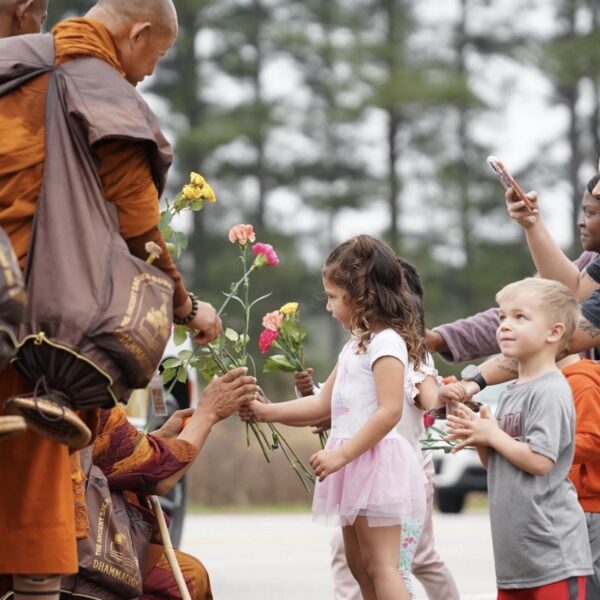
A group of monks is on a 2,300-mile walk from Texas to Washington, DC for peace. They aren’t protesting—they’re practicing peace out loud, one step at a time.
If you’ve been following their journey, you may have seen the prayer they often share:
May all beings be free from hatred, be healthy, be safe, be peaceful and at ease, and may they meet no obstacles in their daily lives.
They explain they’re not praying for a life without difficulty. They know loss, heartbreak, and change arrive uninvited. No prayer can stop the rain or smooth the road—and they don’t ask it to. What they’re praying for is that everyone sees the real obstacle isn’t the situation itself, but how our minds meet it. When we’re afraid, angry, or trying to control what we can’t, even small problems become suffering, not just because of what’s happening, but because we’re fighting against it. The monks aren’t immune to fear or frustration—they just don’t organize their actions around it.
Their prayer asks not for a life free from difficulty, but for a mind free from seeing difficulty as an obstacle. They show us this every day on their walk. Rain, cold, long miles—even injury. One of the monks lost his leg after being struck by a car. From his hospital bed, he reflected that suffering is an inherent part of life, and that despite his injury, he was grateful the incident brought wider awareness to their walk. The journey continued, showing that even profound loss doesn’t have to stop us.
In the words of the monks, “When we cultivate mindfulness like tending a garden, something beautiful unfolds. The walls we thought were solid begin to dissolve like mist in morning sun. We begin to see difficulties, not as enemies to fight, but conditions to move through with grace.”
And when you walk near the monks—even for a short stretch, even virtually—something surprising happens. You feel it. Your breath slows. Your shoulders drop. Your thoughts soften.
They’re Not Walking For Peace. They’re Walking As Peace.
Their walk is not a protest. It’s a practice. They walk slowly, silently, and deliberately, with the intention of peace—not relying on signs or shouting, but by embodying peace so consistently that it disrupts the spread of unrest. They understand you can’t create peace by demanding it, only by refusing to participate in its opposite.
Their example eases the space around them: someone nearby feels their own nervous system soften—even briefly; and another person pauses instead of reacting. Peace spreads the same way panic does—socially, person to person.
What Embodying Peace Can Look Like (Practically)
This isn’t monastery-only wisdom. In ordinary life, peace can look like:
- Pausing before responding, even when you’re “right”
- Letting silence exist without filling it to manage discomfort
- Feeling the urge to defend yourself—and not obeying it
- Refusing to abandon yourself to preserve harmony
Peace isn’t conditional—it’s not dependent on outcomes, and it’s not passive. It’s seeing clearly and acting exactly as needed, no more, no less.
In practice, when you’re struggling, there is no “I shouldn’t feel this.” The first step is letting the feeling be fully felt in the body. The next step is separating experience from story. What’s happening is often different from the story you’re telling about it: This shouldn’t be happening. I’m failing. They’re wrong. Stop feeding the story and look for attachment. Ask: What outcome do I believe I need in order to be okay? Where am I insisting life be different so I can relax?
Next, before engaging anyone else, regulate. Sit. Walk. Breathe. Wait. Not to avoid action—but to prevent reactive action. Clarity that arises while the nervous system is on fire cannot be trusted.
Then, from a steady place, one of two things happens:
- Action becomes obvious—set a boundary, tell the truth, or walk away.
- Or the need to act fades—the problem no longer feels urgent once you’re less attached.
What History Suggests About Peace
We tend to think of peace as something achieved once conditions improve, agreements are reached, or the right people are in charge.
History tells a different story.
One example is the fall of the Berlin Wall. The end did not arrive all at once—but there was a moment when the balance shifted. In 1989, East Germany was a heavily surveilled, militarized state. Everyone knew a violent uprising would have been met with overwhelming force. So resistance took another form: Monday night prayer walks in Leipzig—nonviolent gatherings that began as prayer meetings and turned into candlelit walks. The candles mattered because a flame demands steady hands and slow steps. Violence would have extinguished it.
The demonstrators repeated one phrase, calmly and consistently: Keine Gewalt. No violence.
On October 9, 1989, seventy thousand people walked peacefully through Leipzig. Security forces were deployed. Hospitals were prepared for casualties. Orders to fire were expected.
Nothing happened.
Faced with calm, unarmed citizens moving slowly through the streets, officials and soldiers hesitated. The system had prepared for riots, aggression, and chaos. It didn’t know how to respond to calm, disciplined presence.
Weeks later, the Wall opened—not through force, but through confusion, hesitation, and loss of narrative control. Guards opened the gates after a bungled announcement drew peaceful crowds—and no one was willing to order violence. The system didn’t fall dramatically. It unraveled.
The Berlin Wall didn’t fall because peace was demanded. It fell because enough people refused to behave the way the system needed them to.
Peace didn’t defeat power. It exposed its emptiness when participation was withdrawn.
The Aikido of Peace
There is a useful parallel here to the martial art of Aikido, which is built on one principle: Don’t oppose force head-on. Redirect it until it collapses under its own imbalance. It doesn’t seek to injure the attacker. It seeks to neutralize the attack.
Nonviolent movements do the same: they withdraw the participation that aggression requires. Power that cannot take hold is like fire without oxygen—it fails.
Walking It Forward
Global peace doesn’t begin with agreement. It begins when one person refuses to pass their unrest on. The monks are showing a way. Step by step. Breath by breath.
Walking beside them, even briefly, reminds us that peace isn’t the destination. It’s how we walk—and it changes the quality of the journey.
History suggests this is enough to change outcomes.