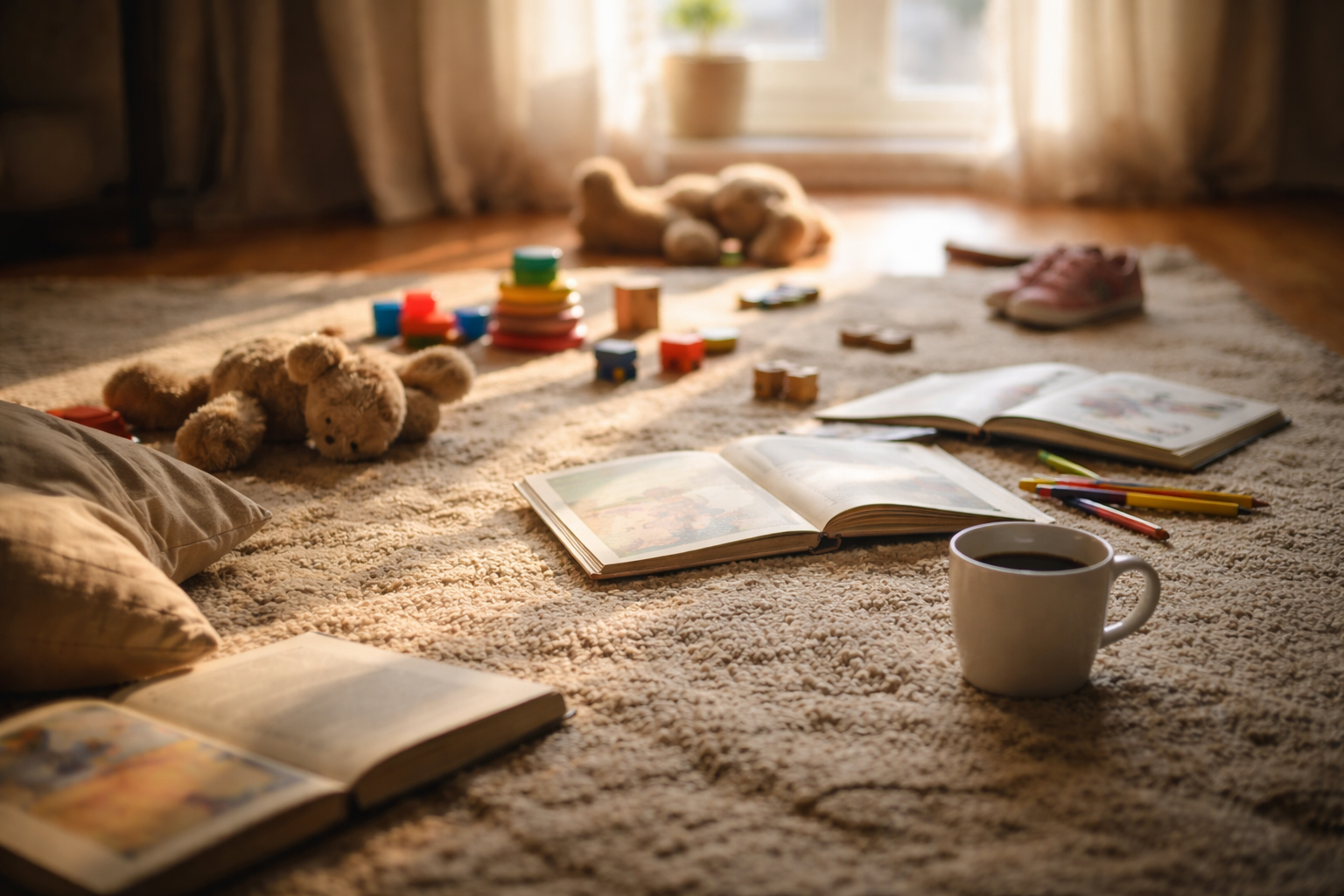
Sitting on the floor playing with my granddaughters, I had a thought.
This is all that matters.
Not what we’re doing—just the connection between us.
They’re four and five. Which means the game changes every thirty seconds, the rules are made up, and nothing leads anywhere specific. No goal. No subtle pressure to turn the moment into something useful or productive. There was nothing to prove, nothing to get right.
Being there with them was all that mattered.
A lot of what fills my days doesn’t feel like that. It feels like stepping into roles, hitting marks, moving things forward. Necessary, yes. But also… like I’m an actor going through the motions on a stage. It made me think of the line: All the world’s a stage.
It’s not just that we play roles—it’s that we forget they’re roles. We start to believe them. We cling to identities: the parent, the success, the failure. We defend them like they’re real.
We’re all playing parts. And the longer you play a role, the easier it is to forget you’re playing it. But if you saw it that way—like you’re playing a role—it might feel more playful. You might take yourself a little less seriously. Still important. Just not the point.
Sitting on the floor with two little girls who couldn’t care less about any version of me I’ve constructed—I wasn’t performing any role. I was just there.
Most of life is built around things that look important: work, schedules, responsibilities, how we’re perceived, what we accomplish. It’s not that those things aren’t important, but they’re not the point.
They’re the set.
We spend so much time adjusting the lighting, fixing the props, making sure everything looks right, that we miss what actually matters—what’s happening between us while we’re on the stage.
Imagine standing alone on a stage with no audience. Does the performance still matter—without others?
The Stoics would say most of what we stress about isn’t even in our control–outcomes, opinions, status. What’s inside our control is attention. Presence. How we show up in the moment.
Playing on the floor with my granddaughters? That’s entirely in my control. It requires nothing except that I actually be there. And kids know the difference. The second you’re not really there, they lose interest.
And somehow, that’s the part we often overlook.
Buddhism would say it felt that way because I wasn’t trying to get anything from the moment. I was just with them. Kids live there naturally. They’re not trying to extract value from a moment. They don’t need it to go anywhere. They don’t need it to prove anything.
They just play. Adults… don’t.
One of my granddaughters created an imaginary cricket. She named it Jiminy. The other one pretended to take it, and suddenly it wasn’t just a game anymore. The one who created it got upset. She wanted her cricket back.
So I told her they could both have crickets. But that wasn’t enough. She didn’t want just any cricket—she wanted hers.
So I made up another one. Gave it to my other granddaughter and asked her to name it—her own special cricket.
Problem solved.
But what stayed with me is this: there was no cricket. None of it was real.
And yet… it was. The feeling of it being hers was real.
We think imagination is something children grow out of. But we don’t. We just change what we believe in.
We get the promotion—and now we matter.
We get the attention—and now we’re enough.
We lose the attention—and now we’re not.
Nothing about us actually changed. But it feels like it did.
There’s no actual “cricket.” And yet… it feels real.
We turn everything into something. A result. A takeaway. A measurement of whether we’re doing life right. Even the good moments. And in doing that, we drain the life out of them.
So, how much of what we call important is just… performance—playing the part, saying the lines, hitting the marks?
We don’t get to opt out of the roles. But we do get to decide how we show up inside them. Whether we’re just going through the motions…or fully there.
That’s the difference.
Maybe life isn’t just a stage. Maybe it’s also a kind of playground—where we try things on, step into different roles, see what fits, what doesn’t, and learn as we go.
That moment on the floor mattered because I wasn’t performing “good grandmother.” I wasn’t trying to do it right. I wasn’t thinking about how it looked.
I was participating. Fully.
What matters most isn’t the structure around us, but what moves through us. The connection. The aliveness. The love that shows up in ordinary moments when we stop trying to control them.
The “play” of life—the jobs, the routines, the responsibilities—creates the structure. But the point isn’t the structure. It’s what happens inside it. The stage exists to create the conditions. The real thing is what flows between people on it.
That moment with my granddaughters didn’t feel like a break from life. It felt like life—stripped down to what matters.
I’m not going to pretend I can live on the floor playing games all day. That’s not real either. Life has responsibilities. Things still need to get done.
But what would it look like to bring more of that kind of presence into the rest of my life? Maybe it’s just small shifts—less performing, more participating, less proving, more being, less rushing past moments, more actually inside them.
The goal isn’t to escape the stage. It’s to stop forgetting that it is one—and pay attention to what matters while we’re on it.